When teams play as one: what group flow feels like
There are some performances that deliver above and beyond. When the orchestra plays as one extension of an integrated instrument driven by a common heartbeat, it is a magical and memorable performance for the musicians. Discerning audience members are moved as well, without participating, they feel and appreciate the exceptional flow of the performance. This is team flow.From individual flow to group flow
Previously we discussed Mihaly Csikszentmihalyi’s work on individual flow (Flow: The Psychology of Optimal Experience). His work has been built upon by Keith Sawyer, who developed the concept of Group Flow in his book Group Genius: The Creative Power of Collaboration. Sawyer believes that group flow is more powerful than individual flow, and it can lead to exceptional innovation. His premise is that collaboration is more important for innovation in today’s business world than individual innovation (http://keithsawyer.com/groupgenius/excerpt.php). It is not easy to get the collaborative web right, yet when you do, your company can innovate and lead its industry.Five conditions leaders can influence to improve team performance
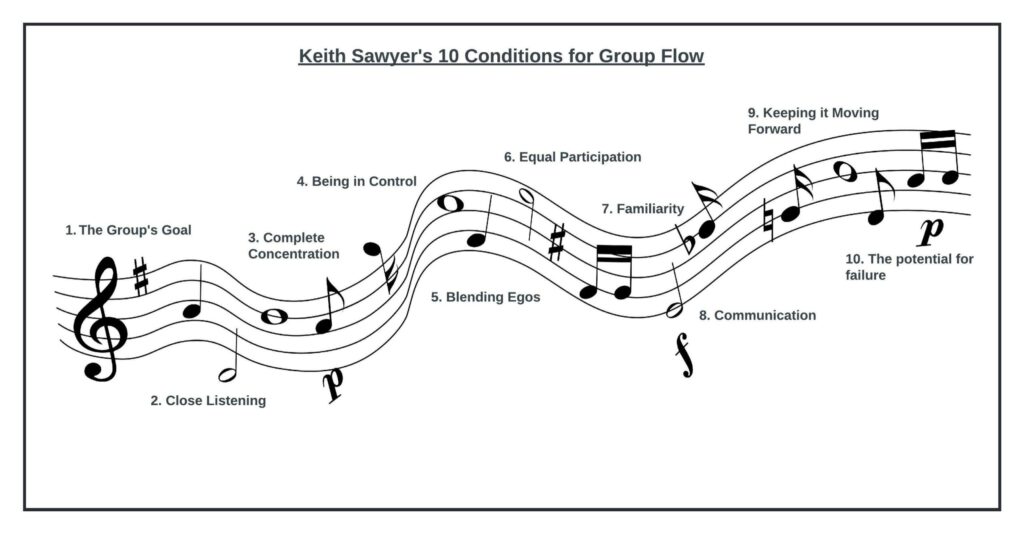
A. The group’s goal
The goal needs to provide just enough focus so that team members can tell when they get closer to a solution, while staying open-ended enough for problem-finding creativity to emerge.
B. Complete concentration
The team needs an environment where they can focus on the goal. Creativity is often built upon many interactions and inputs over time, so high-pressure deadlines do not help. Leaders who can provide this kind of buffer will help their teams.
C. Equal participation
Members should have comparable skill levels and participate equally. Managers can participate in groups in flow, yet they need to participate in the same way as everyone else, engaging in close listening and granting autonomy and authority to the group’s emergent decision processes.
D. Communication
Constant communication is required. This often happens in spontaneous conversations in the hallway or after work, rather than only in the boardroom. Make sure the team has the leeway to discuss the project in informal settings.
E. The potential for failure
There is no creativity without failure, and there is no group flow without the risk of failure. A culture that accepts and even rewards failures as learning experiences that move the organization ahead will support team flow.
The long-term dividends of group flow
If you have experienced group flow in sports, music, or the performing arts, or even better, in your work environment, you understand the powerful impact it has on performance and on future team dynamics. Group flow may require significant effort, and it may not happen every day, yet its positive impact will pay long-term dividends. Leaders who cultivate group flow to improve team performance create conditions where innovation and cohesion thrive.