There is no shortage of things that go ring and go ding around us wherever we are, emails coming in, text messages, group texts, Twitter, LinkedIn, Facebook, calendar notifications, just to name a few. Because so many people live in an “I need it now” paradigm, we dare not miss what is coming in. As in FOMO, because YOLO. If you lead a team, attention management for leaders starts with taking back your time and your focus.
Constant distraction leads to a lot of wasted time, unproductive time, and things not getting done. Research by Gloria Mark revealed that a 30 second distraction, a quick text or tweet, costs you 25 minutes plus the 30 seconds. It takes about 25 minutes to regain your train of thought and re-engage with your work. Distractions do not just eat up time during the interruption, they derail your mental progress for up to a half hour afterward, assuming another distraction does not show up in that half hour. Mark says that the average person checks email 74 times a day, and she has seen 465 times per day on the high end.
Everyone has distractions all day long in addition to emails. Imagine what you could get done with no distractions.
The cost of constant distraction
- The cost of distractions rises far above lost productivity.
- Lost productivity increases stress and frustration.
- High usage of technology correlates with higher levels of depression.
- Regular distractions erode our capacity for deep thinking and creative problem solving.
Attention management for leaders: break the habit
- Budget your time. It is a nonrenewable resource. Nir Eyal offers a clear way to decide whether you are moving forward or not, traction versus distraction.
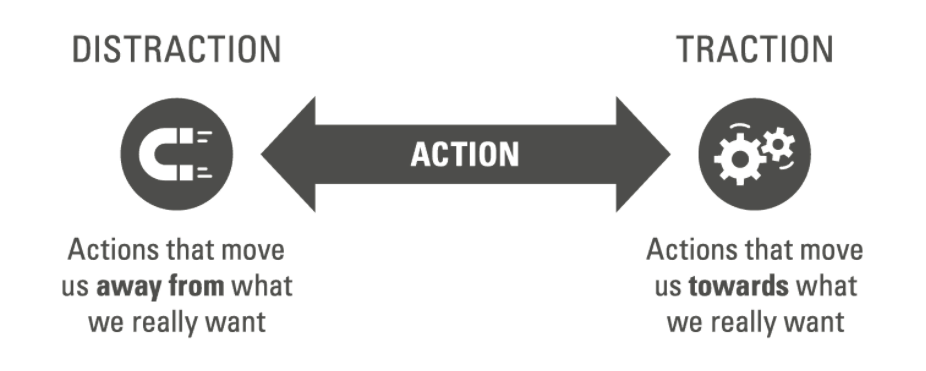
- Schedule focus time. Many senior executives schedule time to think. Time to sit and think, jot down a few thoughts, and explore ideas. Time for ideation is crucial for your growth as well as the growth of your company.
- Schedule what matters. Put events in your calendar according to what is important to you. Where you spend your time is where you will see results.
- Use anti-distraction apps. A simple trick like putting the phone on airplane mode or Do Not Disturb allows you to take control of your attention and look at the phone when you have time to do it. There are productivity tools such as SaneBox that analyze your email activity to understand what emails matter to you and which do not, then sort incoming emails accordingly. Search “productivity tools” for the many options available.
- Switch off notifications. There is no reason for every application on your devices to make you aware of what is happening. If you schedule time for email and other sources of information, you will get stuff done and stay on top of the stream of communications. Plenty of apps can help with this as well.
Attention management for leaders is a practice. Start small. Protect one block of focus time today and notice the difference in the quality of your work and your decisions.
“You say you don’t have time. You have exactly the same number of hours per day that were given to Helen Keller, Pasteur, Michelangelo, Mother Teresa, Leonardo da Vinci, Thomas Jefferson, and Albert Einstein.” — H. Jackson Brown Jr.