"The greatest tragedy for any human being is going through their entire lives believing the only perspective that matters is their own. "
— Doug Baldwin
In a recent sermon, our pastor highlighted the importance of considering more than one perspective. His visual aid was several pictures of a giant sturgeon taken from various angles. In some, it looked small, and then eventually, being held by 4 large men—it was a very big fish.
The angle from where we see a person, an event, an entire history, journey, or movie will inform the “truth” in our heads and hearts. Different perspectives give us different angles of the “truth.” We could, of course, go into a lengthy existential or philosophical debate about “what is truth?” or even “What is reality?”
However, what is weighing on my mind on this topic is relationships. In our work with leadership teams that are stuck, have dysfunctional relationships, or out of control conflict, it is always the limitations on perspective that stand out. When we coach through a team interaction that did not end well, I often hear a sentence ending with “…… and that is what should have happened. That would be normal, right?”
Here’s the challenge: it’s difficult to accept that there are multiple versions of “normal,” various interpretations of the truth, or of reality when your own truth is closely tied to your values and sense of self. Therefore, by igniting change and opening up the possible variations of reality, truth, and events, the gain can be exponential.
Understanding Ourselves First
“We don’t see things as they are, we see them as we are.” ~ Anaïs Nin.
When we understand which voices or experiences informed our worldview, perspectives, and beliefs, it may in itself become an exercise of perspective.
The next gain is relational. People feel valued when they are heard from where they are, not where we want them to be. Stressed relationships, in and outside of work, compromise our openness, growth, and safety. Continued relational strain in leadership teams can become a cultural cancer that will compromise the overall performance of the organization. Great working relationships open up possibilities, create psychological safety and belonging.
Better Problem Solving with Different Perspectives in Leadership
Being open to different perspectives in leadership is crucial for effective planning and comprehensive problem solving. It opens the doors to innovative ideas which may have been overlooked or squashed otherwise.
Personal Growth and Curiosity
Finally, making a concerted effort to learn about new perspectives fosters personal growth. In today’s global and hyperconnected world, this is more than a nice-to-have—it’s essential. Leaders across all industries benefit from curiosity and a willingness to learn from others. This broadens our empathy, deepens our thinking, and strengthens our contribution to an inclusive, respectful society.
The Choice Map: React or Reflect?
"Change your questions, change your life"
— Marilee Adam, PhD
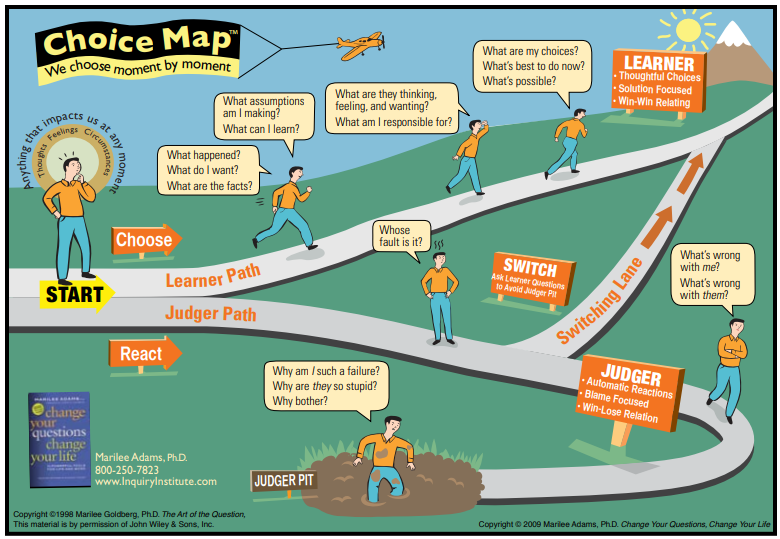
Marilee Adams’ Choice Map offers a practical framework for navigating different perspectives. Whenever we are faced with a different perspective, a new reaction, or something deviant from our own “normal,” we have a choice:
- Judge, be all self-righteous, and diminish the other person’s perspective, reaction, or actions; or,
- Be Curious, ask sincere open-ended questions to understand the other perspective.
By seeking to understand and respect others, we pave the way for a brighter, more compassionate future for all. Let us celebrate the uniqueness of each individual, for it is through diversity that we find our greatest strength.