Every December, the new year memes show up with a weird mix of humour and apprehension. That tension is not a leadership flaw, it is a signal. People are scanning for risk, change, and overload, and they are also looking for someone who can turn that noise into direction.
This is where Think and Grow Rich (Napoleon Hill), still lands, if you read it through a modern mind + behaviour lens.
Napoleon Hill wrote in a different era, and some of his “mind” claims do not hold up as literal science. The real value is what sits underneath: a practical blueprint for self-regulation, attention, habits, and execution. Translate the concepts into modern psychology, and you get a leadership playbook that can be applied cleanly, without the mystical packaging.
What still holds up, and how to modernize it
1) Definiteness of purpose becomes specific goals plus constraints
Hill’s “definite purpose” maps directly onto goal-setting research: specific, difficult goals reliably outperform vague “do your best” intentions.
Modern upgrade: goals need more than a target, they need definition.
- Success criteria: what “good” looks like, in observable terms.
- Constraints: what must not be violated (values, safety, budget, capacity).
- Feedback loops: how you will know, weekly, if you are drifting.
When leaders skip constraints and feedback, they end up with ambitious goals that quietly create chaos. When leaders add them, they reduce decision fatigue because the trade-offs are already pre-decided.
“You do not rise to the level of your goals. You fall to the level of your systems.” — James Clear
Micro-practice (3 minutes):
- Write the goal in one measurable sentence.
- Add two constraints that protect what matters.
- Choose one weekly metric that will tell you early if you are off track.
2) “Faith” becomes self-efficacy, belief you can execute
Hill treats faith as fuel. Modern psychology calls the useful version self-efficacy, a person’s belief in their capability to perform a specific behavior. Bandura’s early work is still foundational here. This matters for leaders because confidence is not “vibes”, it shapes persistence, strategy use, and resilience under pressure. Bandura outlines four practical sources of self-efficacy. Teaching at Sydney
“The fixed mindset does not allow people the luxury of becoming. They have to already be.” — Carol S. Dweck
Modern leadership application of the four pathways:
- Mastery experiences: build small wins that are real, then scale the difficulty. This is the strongest driver.
- Vicarious experience: watch credible peers handle the moment, not hero stories, actual process.
- Verbal persuasion: coaching feedback that is specific and tied to strategy, not generic praise.
- Physiological and affective states: teach leaders to interpret activation as readiness, not incapability, and train regulation skills so they can access their competence under load.
Modern upgrade: stop trying to “pump confidence”. Build it through reps, modelling, and well-timed feedback, then stress-proof it.
3) Auto-suggestion becomes strategic self-talk and cognitive reframing
Hill’s autosuggestion is basically deliberate self-talk, the internal script that runs your behavior when stakes rise. Self-talk interventions have meta-analytic evidence showing a moderate positive effect on performance in demanding tasks. PubMed+1
Modern upgrade: replace vague affirmations with reality-based prompts that keep you effective.
- “What is the most useful interpretation that still respects the facts?”
- “What is the next smallest responsible action?”
- “How do I want to be experienced in this moment?”
Leader-level truth: your internal voice is often the hidden operating system behind how you lead conflict, change, and accountability.
4) Imagination becomes mental rehearsal, not outcome fantasy
Hill praises imagination and visualization. Modern research supports mental practice as beneficial for performance. The key update is how you rehearse. Pure “I see the win” fantasizing can feel good, but it often fails under pressure because it does not prepare you for friction. What performs better is pairing the desired outcome with the likely obstacle, then planning your response.
That combination is strongly aligned with:
- Mental contrasting (desired future + present obstacle), with supportive meta-analytic evidence. PMC
- Implementation intentions (“If X happens, then I do Y”), with meta-analytic evidence showing meaningful effects on goal attainment. KOPS+1
Modern upgrade: rehearse the first minute of action and the first obstacle, not the victory speech.
5) The “subconscious mind” becomes habits and automaticity
Hill’s subconscious language maps cleanly to habit science: cue-driven, automatic responses that run even when willpower is low. Habit formation is not instant. In a widely cited real-world study, automaticity averaged around 66 days, with large variation. Wiley Online Library+1
Modern upgrade: treat reliability as design, not personality.
- Put the cue in the calendar.
- Use meeting agendas and decision templates as behavioral scaffolding.
- Reduce friction for the right behavior, increase friction for the wrong one.
In organizations, culture is basically the team version of habit. Leadership credibility is habit, under pressure.
6) “Master Mind” becomes collective intelligence and interaction quality
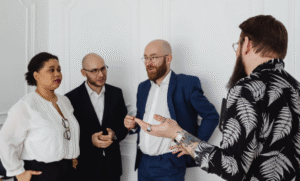
Hill’s Master Mind is not charisma, it is collective intelligence. Research on group collective intelligence found a “c factor” that predicts performance across tasks, and it is linked to interaction norms like social sensitivity and more equal turn-taking. A modern mastermind or leadership circle acts as a live feedback loop that sharpens decisions and follow-through. Research suggests collective intelligence depends less on individual brilliance and more on interaction quality and balanced participation. Like a community of practice, it creates compounding growth through regular shared learning and real-world application.
Modern upgrade: the smartest team is not the one with the biggest resumes, it is the one with the strongest conversational discipline. Join a mastermind!
Mindful habits that turn insight into execution
Here is a simple, modern “Hill, updated” protocol that leaders can actually sustain.
“The real meditation is how you live your life.” — Jon Kabat-Zinn
The 10-minute daily protocol
- Define today’s critical outcome, measurable. Stanford Medicine
- Mental contrast: desired outcome, biggest obstacle that is likely to show up. PMC
- If–then plan for that obstacle. KOPS
- Rehearse the first 60 seconds of action (process rehearsal). ScienceDirect
- Write one pressure reframe you will run. PubMed
Add mindfulness as a supporting habit, not a personality trait. Workplace mindfulness training has meta-analytic evidence across outcomes like stress and well-being.
This is the positive takeaway:
You do not need perfect circumstances to lead well.You need a few modern, evidence-aligned mental and behavioural systems that make you steadier, clearer, and more human, especially when it counts. – Marderé Birkill