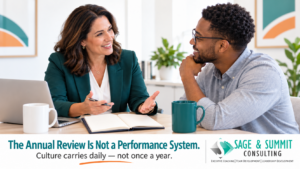
Trust isn’t a poster. It’s not a line in your annual report, and it’s certainly not something you can announce into existence during a Monday morning town hall. In the 2026 professional landscape, trust has moved from a “soft value” to a critical survival metric.
But here is the uncomfortable truth: Most leaders are currently failing the test.
According to the latest data from the Edelman Trust Barometer, there is a massive 29-point credibility gap between the expectation that CEOs bridge trust divides and their actual performance in doing so. We are living in a world sliding into “insularity,” where seven in ten people are hesitant to trust anyone with different values.
If you feel like you’re shouting into a void, you aren’t alone. But you also can’t afford to stay there.
The View from the Glass Fishbowl
As a High-Stakes Navigator, your reality is being squeezed from every side. You are dealing with AI disruption that makes your team feel replaceable, KPI pressure from above that feels relentless, and a “mass-class divide” that has doubled in the last decade. You are operating in a VUCAH (Volatile, Uncertain, Complex, Ambiguous, and Hyper-connected) environment where the old “command-and-control” playbook isn’t just outdated, it’s dangerous.
When trust erodes, the system grinds to a halt. Employees put in less effort, they retreat into safe “insular circles,” and they stop sharing the very insights you need to make fast, accurate decisions .
Quick Insight: If you’re still managing through command-and-control, you’re not leading, you’re managing fear.
Imagine, instead, walking into your office (virtual or physical) with a grounded, calm energy. Imagine a team that doesn’t just wait for your “source of truth” but meets you with their own. Imagine a room where silence doesn’t mean agreement, but where your team feels safe enough to disagree productively because they know you are a Trust Broker, someone who surfaces common interests and translates realities across insulated groups .
The Identity Shift: From Truth-Teller to Trust-Broker
Market domination in the leadership space requires more than just better “optics.” It requires an identity shift. In the past, the leader was the “Truth-Teller”, the expert with all the answers. In 2026, the machine (AI) handles the “truth” of data faster than you ever could. Your value now lies in your ability to broker trust between people, machines, and diverging values .
Level 1: The Simple Reframe
Trust isn’t something you have; it’s something you do. Traditional leadership treats trust as a bank account, you make deposits and hope for interest.
People-centered leadership treats trust as a bridge, you build it, plank by plank, through dialogue.
Level 2: The Applied Example
Consider the “Mass-Class Trust Gap.” In the U.S. alone, the trust gap between high- and low-income groups has widened to 29 points . If you are leading a diverse, hybrid workforce, your team is likely split across these divides. A Trust Broker doesn’t ignore these differences; they make them visible. They don’t demand alignment; they facilitate understanding.
Short Question: Where are you holding onto tasks or decisions because it feels “easier” than navigating a difficult conversation?
Level 3: The Deeper Nuance (Why This Is Hard)
It is hard because our brains are hard-wired for the “safety of the familiar.” Richard Edelman notes that we are favouring “me over we” and “nationalism over global connection” . When you step into the role of a Trust Broker, you are acting against the current of society. You are choosing the risk of change over the safety of the familiar.
Level 4: The Identity Upgrade
This is where vertical development happens. You move from being an “Achiever” (focused on results and expertise) to a “Catalyst” (focused on developing capacity in others). You stop being the funnel for every decision and start being the filter for the team’s energy.
The EBITDA of Empathy
Some will hear this and think, “This sounds like therapy, not business.”
Let’s look at the ROI.
Healthy organizations, those that prioritize trust, direction, and employee empowerment, deliver three times the total shareholder returns (TSR) of their unhealthy peers. When you build a culture of psychological safety, you aren’t just being “nice.” You are increasing productivity by 16% and profitability by 21%.
Trust is a performance multiplier. When trust in a manager drops (and currently, only 29% of employees trust their direct manager), disengagement follows . Disengaged employees are 59% more likely to represent a financial distress risk to the organization.
Reframe: Delegation isn’t losing control, it’s teaching it.
The Playbook: How to Broker Trust Today
To bridge the credibility gap, you need a structured “Coach Approach.” You need to move beyond declarations and into repeatable habits that create an inspiring environment where everyone thrives.
1. Conduct a “Trust Audit”
Stop guessing how your team feels. Look for the “warm bath” syndrome, where employees are engaged but comfortable, failing to produce results in high-stakes areas. Use the Coach Approach framework to measure your “health baseline.”
2. Practice Sacred 1:1s
Your one-on-ones should not be status updates. Status updates can be handled by SAGE AI. Your 1:1s are for Relational Intelligence. Try this script: “What’s the one thing we aren’t talking about that’s slowing us down?” or “What does success look like for you here, beyond the numbers?”
3. Build a “Leadership Factory”
Don’t just spot talent; manufacture it. Build systems where every manager is trained in constructive dialogue. Research shows that 80% of employees believe dialogue training can promote trust. This is the core of our Coach Approach program, turning leadership into a source of energy, not exhaustion.
4. Normalize the Challenge
Trust-building is messy. It involves “bounded vulnerability”, being real without collapsing under the weight of the team’s stress. When things get hard, don’t retreat. That is the moment to double down on your unwavering purpose.
Quick Tool: Use a “Micro-Leadership Moment.” A 30-second interaction that creates clarity or recognizes a win releases dopamine in the brain, creating an “Action-Reward Cycle” that stops employee “give-up” cycles.
The Next Step for the High-Stakes Navigator
You are the hero of this story, but you are also the flashlight. You don’t have to carry the weight of every decision alone. You were promoted to lead, not to be the bottleneck.
The 29-point gap is your opportunity. While others are retreating into insularity, you can be the bridge-builder. While others are managing fear, you can be the one cultivating a resilient, emotionally intelligent team.
Your Action Step for Today: Choose one decision you typically make on your own—something tactical and low-risk. Ask a team member, “What options are you considering for this?” and then let them choose.
This is the first plank in your bridge.
Because the real shift isn’t in your calendar or your organizational chart. The real shift is in who you become when you stop bottlenecking your own impact. You become the leader your team has been looking for, the Trust Broker who turns uncertainty into clarity and purpose into action.