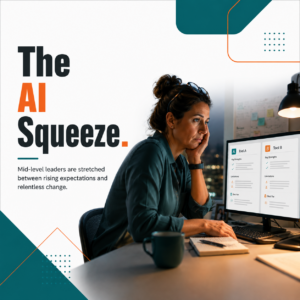
It is 8:40 on a Tuesday night. One of your best supervisors has two browser tabs open, comparing two AI note-taking tools, because the last one the team adopted would not talk to the scheduling system. This is the third tool this quarter. Earlier that day, a technician stopped at her desk and asked, in a lower voice than usual, whether the new software meant the company would need fewer people like him.
She did not have a clean answer for either problem. So she carried both home.
If you have rolled out AI in the past year and your managers seem more tired rather than less, the tools are probably working. That is not the issue. The issue is where the load went. AI did not remove work from your organization. It moved work to the layer least equipped to absorb it, and it arrived carrying two different pressures at the same time. We call the result the AI Squeeze.
Why the load lands on the middle
Here is the pattern we keep seeing in growing engineering, manufacturing, and construction firms. When AI enters the business, three things happen to your middle managers at once. They are asked to own the rollout for their team. They absorb their team’s fear about what AI means for their jobs. And they are measured against a quiet new expectation that output should be higher now, because the company bought the tools.
Each of those is a full initiative. Companies run all three through the same management layer, at the same time, and assume the layer will simply hold.
It helps to be precise about how loaded that layer already was. Gartner’s 2024 survey of HR leaders found that 75 percent report their managers are overwhelmed by the expansion of their responsibilities, and roughly seven in ten say managers are not equipped to lead change. That was the baseline before AI became a standing agenda item. And the layer is not growing to meet the demand. Recent reporting shows manager headcount contracting as firms use AI to flatten their structures. The load is rising, the layer is thinning, and the plan is for the people in the middle to make up the difference with effort.
That is the trap. The manager becomes the shock absorber for a change no one fully decided how to run.
AI anxiety and AI fatigue are not the same problem
The most useful thing a leader can do here is stop treating this as one thing. Underneath the AI Squeeze are two different pressures, and they need two different responses.
The first is AI anxiety. This lives mostly with the team. It is the fear of being replaced, the worry about what a tool means for a role someone has held for fifteen years. Pew Research Center’s survey of more than 5,000 workers found that 52 percent are worried about AI’s future impact on work, and about a third already feel overwhelmed by it. Anxiety is a trust and communication problem. It gets worse in silence, and better when a leader says plainly what AI is for and what it is not for.
The second is AI fatigue. This lives mostly with the managers themselves. It is not fear. It is exhaustion from the constant work of evaluating, adopting, monitoring, and correcting tools. Researchers have started calling the sharp end of it “AI brain fry.” A 2026 study by Boston Consulting Group and the University of California, Riverside found that workers with heavy AI oversight responsibilities reported measurably more mental effort, more fatigue, and more information overload than those with little. Closer to home, researchers in Alberta have described the same thing in plain terms: keeping up with a constant stream of new tools and shifting expectations is wearing people out.
If you respond to fatigue with reassurance, you miss it. If you respond to anxiety with another training session, you make it worse. One needs clarity about the future. The other needs relief in the present. Naming which one you are looking at is the first act of leadership here.
The instinct that quietly makes it worse
You did not do anything wrong by buying the tools. The instinct is sound. You saw your leaders stretched, and you invested in something meant to help.
The trap is what happens next, and it is quiet. Once the money is spent, a reasonable question forms: where is the return. Felt by the team, that question becomes a new expectation. Produce more, because we gave you the tools. No one says it in those words. It does not need to be said. The managers hear it anyway, and they stack AI on top of an already full plate instead of using it to clear the plate. The tool that was meant to create room becomes one more thing to manage. That is not a failure of the technology.It is a decision that was never made.
The lever is leadership, not the software
Here is the part that should change how you think about this. The tools are not the variable that decides whether AI adds load or removes it. Leadership behaviour is.
The same research that named AI fatigue also found what reduces it. Employees reported less fatigue when their managers made time to answer questions about AI. Teams that built AI into shared, agreed workflows carried less strain than teams where everyone adopted tools on their own. And the strongest driver of fatigue was not technology at all. It was the belief that the organization now simply expected more, because the tools existed.
Read that again, because that is the whole point. The difference between AI that relieves your managers and AI that grinds them down is not the software you chose. It is whether leadership decided what the tools are for, said so out loud, and adjusted what it expects in return. That is an operating culture question. It does not show up in the tool’s dashboard. It shows up everywhere in your managers’ calendars.
What changes on Monday: the task audit
So what do you do instead? Not adopt another platform. Make a decision, and give your managers a way to make it visible.
The move we give leaders in this spot is a task audit, and it belongs to the manager, not to IT. Ask each manager to track where their week goes for five working days. Then sort every recurring task into one of two buckets.
The first bucket is low-value admin: status updates that could be a shared board, meeting scheduling, first drafts of routine reports, chasing information that should already live in a system. These tasks drain energy and need almost no judgment. This is the work AI is genuinely good at, and the work you want it to take.
The second bucket is the human core of the job: the decisions, the coaching moments, the difficult conversation with an underperformer, the judgment call on a safety issue, the read on whether a strong team member is quietly overloaded. AI does not do this work, and it should not touch it. This is what you want to protect and give the manager more room for.
Most rollouts fail their managers because they add tools on top of both buckets and change nothing about the expectation. The audit forces the decision the rollout skipped: what is AI here to take off the plate, so the manager has more room for the work only a person can do. A first draft that used to cost forty minutes now costs four to edit. Decide that first. Then adopt the tool.
What the other side looks like
Picture the same supervisor two months after that decision. The status report writes its own first draft, and she edits it in four minutes instead of forty. The scheduling runs itself. The technician who was worried has heard clearly, from her, what the company is using AI for and what it is not, and he has stopped bracing for bad news. She is not evaluating a new tool this week, because leadership decided that adopting three tools a quarter was the problem, not the solution. She has room for the one conversation on her team that genuinely needed her.
Nothing was transformed. A decision was made, said out loud, and reinforced. That is what a culture that carries the business looks like when technology arrives.
The next step
If your managers are more tired since AI arrived, that is worth a conversation before it is worth another platform.
Book a 20-minute conversation. Bring one question. We will spend the time on the question.
FAQ
What is the AI Squeeze?
It is the pressure that concentrates on middle managers during an AI rollout. From below, they absorb their team’s anxiety about being replaced. From above, they carry an expectation of higher output because the tools were purchased. The manager in the middle becomes the shock absorber for both.
What is the difference between AI anxiety and AI fatigue?
AI anxiety is fear, usually held by the team: worry about job replacement and what tools mean for their role. AI fatigue is exhaustion, usually held by managers: the mental drain of constantly evaluating, adopting, and checking new tools. Anxiety needs clarity and candid communication. Fatigue needs relief and clearer priorities.
How do I reduce AI fatigue in my managers?
Decide what AI is for before adding another tool, and say it out loud. Then have each manager run a five-day task audit that separates low-value admin AI should take from the human work it should never touch. Research shows fatigue drops when leaders answer questions directly, build shared workflows, and stop expecting more output simply because the tools exist.