What an Intentional Operating Culture Looks Like in a Technical Business
She asked a question I don’t hear often enough.
Kate’s message arrived on a Tuesday evening.
‘I’ve been thinking about our operating culture,’ she wrote. ‘I don’t think I’ve ever actually designed it. I’ve just built habits and hoped they added up to something. Is there a better way?’
Kate directs a federal infrastructure project, twelve years in the sector, technically exceptional, genuinely invested in her people. And sitting, as a lot of strong leaders eventually do, with the recognition that the operating culture she was responsible for had grown up around her rather than been built by her.
Most operating cultures in technical businesses are like this. Not broken. Not dysfunctional. Just undesigned, shaped by the habits of whoever was in the room, the patterns that got reinforced over time, and the tolerances that quietly became norms.
The interesting question, and the one we spent the next three sessions on, is what it looks like when you build one deliberately instead.
Culture is happening whether you designed it or not
Culture is how decisions are made, problems are raised, accountability is handled, meetings are run, and how people behave when senior leaders are not present.
Not values on a wall. Not the aspiration in the company handbook. What actually happens in the field, on the shop floor, in the site trailer, and in the team meeting when the boss isn’t in the room.
In most businesses, that culture has been shaped by the habits, responses, and tolerances of the leadership team, not as a deliberate design, but as the accumulated consequence of thousands of small decisions: what to reward, what to address, what to let slide.
The technical operations are meticulous. The operating culture got whatever it got. The good news is that it can be designed, and the difference between a designed operating culture and an accidental one is significant.
The Four Layer reality
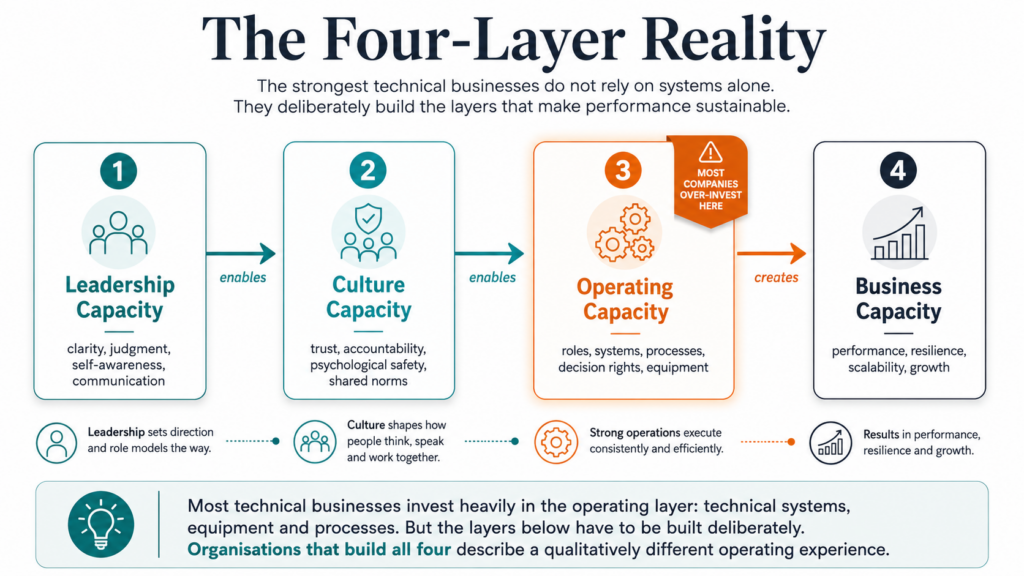
What becomes possible when the operating culture carries more
The people who’ve been carrying the load get their capacity back.
When decision-making moves closer to the work, the senior leaders who’ve been absorbing decisions that didn’t need to reach them find something they’ve been short of: time for the work that actually requires them. That’s not a small change. In most businesses, it’s the difference between running the operation and leading it.
The people below the leadership layer start to develop.
A supervisor who has learned to check in is not developing the capability the organization will need as it grows. A supervisor who has been given clear decision rights, a shared commitment standard, and the experience of owning a problem to completion, that person is building something the organization can rely on. Key-person dependency decreases at every level below, not just at the top.
The business adapts when it has to.
The organizations that adapt fastest to new technology, new sites, acquisitions, and workforce changes are the ones with an operating culture that distributes decision-making and holds accountability at the level where the work gets done. That culture has to be built before the change arrives. The ones built by default find out what they were missing at the moment they can least afford to.
What Kate discovered when she mapped her operating culture
Over three sessions, Kate mapped the operating patterns in her organization against five dimensions: decision velocity, accountability follow-through, problem-surfacing speed, leadership depth, and operating rhythm reliability.
Two were strong. Three had clear room to grow.
Her meetings were well-structured. Her people were engaged. But decision velocity was lower than it could be, too many calls waiting for her sign-off. Problem-surfacing speed was slower than the business needed, issues reached her after they’d become visible, not before. And leadership depth was the most significant starting point: a layer of capable, committed managers who had learned to check in rather than decide.
She hadn’t built that pattern intentionally. She’d built it by being available, reliable, and always ready to provide the answer, and over time her team had learned, correctly, that the answer would come if they waited.
‘I think I’ve been teaching them not to decide,’ she said.
That recognition, made specific, made operational, is the beginning of every meaningful change in operating culture I’ve witnessed. The honest naming of the pattern, followed by the deliberate building of something different.
What building something different looks like, specifically
The Sage & Summit engagement model for operating culture is a sequence, not a programme.
Baseline. Build. Reinforce. Measure. Prove.
It starts with the Culture Capacity Scan, a clear picture of the current operating culture across five dimensions. Not a satisfaction survey. A diagnostic baseline that tells you specifically where decisions are waiting, where accountability is drifting, and where the organization’s ability to surface problems early has been constrained.
From that baseline, three to five agreed indicators are chosen, the specific operating measures that will tell you, over 120 days, whether the culture is moving. Decision distribution. Escalation rate. Problem-surfacing speed. Commitment follow-through. These are leading indicators, they move before turnover or productivity figures do.
At 120 days, a formal measurement review.
- What changed in the operating indicators we agreed to track?
- What moved and what didn’t move?
- What comes next?
Not programme satisfaction. Operating evidence.
If you’re ready to explore what your operating culture looks like when you actually map it, I’d like to be in that conversation with you. Thirty minutes. A clear picture of what the Culture Capacity Scan would reveal and whether there’s a starting point worth building from.