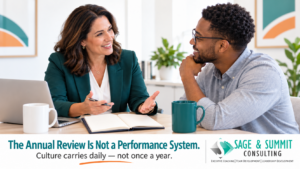
The annual performance review measures the past. Performance enablement builds the daily habits, manager skills, and operating rhythms that improve work in real time. Organizations that shift from annual evaluations to continuous feedback loops report faster problem resolution, stronger manager accountability, and higher retention among high performers.
The Annual Review Is Not a Performance System. It Is a Performance Post-Mortem.
The annual review arrived. The manager spent three hours filling out the form. The employee spent two hours preparing a case for why their rating should be higher. HR collected the results, ran an aggregate, and filed it away.
And not one thing about Tuesday’s work changed as a result.
If that pattern is running in your organization right now, you are not alone. You are also paying for it in ways that will never show up on the form.
What the research actually says
Gallup has been tracking performance management data for over a decade. Their consistent finding: only about 14 percent of employees strongly agree that their performance reviews inspire them to improve. The remaining 86 percent experience the review as an administrative event with little connection to how they actually work.
That number should sit uncomfortably with any leader who is spending organizational bandwidth on an annual cycle. You are running a system that, by the data’s own account, is not changing what it is supposed to change.
Deloitte’s Human Capital research put it plainly: the traditional performance review is built to evaluate the past, not to develop the future. It is a diagnostic tool being asked to do the work of a performance system. The problem is not effort or intent. The problem is that the architecture is wrong.
This matters in 2026 more than it did in 2016. When AI is accelerating the pace of work, when technical teams are being asked to take on more complexity, and when the cost of losing a mid-level supervisor in construction or energy can run well into six figures before you account for the production disruption, the idea that you can course-correct performance once a year is not just outdated. It is an operational liability.
The real cost is not the review. It is the silence in between.
Here is where the financial case gets specific.
Leaders in industry commonly spend six to eight hours per week handling performance-adjacent issues: escalations, clarifications, rework approvals, conflict conversations that should have happened months earlier. A portion of that load exists because feedback loops are too long. A problem that surfaces in October did not start in October. It started in March, when no one named it directly.
The review process is not the villain. The culture of performance silence that grows in its absence is.
- When feedback only happens annually, a few things tend to follow.
- People adjust their behaviour to prepare for the review, not to do the work better day-to-day.
- Managers avoid difficult conversations during the year because the “formal process” is coming.
- High performers stop receiving the recognition they need to stay engaged, because recognition gets deferred to the next cycle.
Gallup’s data puts the cost of disengagement at roughly 34 percent of an employee’s annual salary in lost productivity, a number that compounds when the disengaged person is carrying institutional knowledge or client relationships. And the biggest cost is the one leaders rarely see: the good people who quietly decide their effort is not being seen, and start looking outward.
The reframe: performance is not an event. It is a daily operating rhythm.
Middle managers are not primarily evaluators. They are daily performance architects.
The best ones are having short, honest conversations on a regular cadence. Not formal check-ins with a template. Real conversations. “What is working on this project and what is getting in your way?” followed by an actual answer and an actual response.
McKinsey’s research on organizational health consistently shows that companies outperforming their sectors over time share one characteristic above others: leaders at every level who can surface problems early and address them close to the work. Not because they have better review forms. Because they have built a feedback culture that does not wait for a calendar event to tell the truth.
That is performance enablement. And it looks nothing like an annual review.
The difference is not subtle. An annual review looks backward and generates a rating. Performance enablement looks forward, in real time, and generates a behaviour change. One measures what happened. The other builds what comes next.
What this means for your middle managers
The gap in most organizations is not that managers are avoiding performance conversations. It is that they have never been shown how to lead them.
The technical supervisor promoted from a field role is skilled at the work. They are not necessarily skilled at the conversation that happens when work quality starts to slip, when a strong team member is quietly burning out, or when two people on a job site are creating friction that is slowing everything down.
If your performance system relies on the annual review to surface those situations, the system is not just slow. It is structurally dependent on the leader’s personal willingness to have a hard conversation, with no scaffolding to support it.
That is a cultural problem, not a training problem. You can run a skills session on giving feedback. But if the organization’s operating rhythm does not reinforce feedback as a normal part of the work, the skills do not transfer. They transfer into a folder marked “training we did” and stay there.
Performance enablement builds the daily muscle. Not through a framework. Through repetition, real conversations, and leadership accountability for the quality of feedback, not just the completion of the form.
Three questions worth answering before Q4 starts
How long does it take a performance problem to reach the executive level in your organization? If the honest answer is weeks or months, the feedback loop is too long. Something is absorbing the signal before it travels.
What does your middle manager do on the day they notice a performance issue? If the honest answer is “waits for the right moment” or “brings it to HR,” the accountability architecture is unclear. The manager may not know what they are allowed to address and what requires a process.
When did your last high performer receive meaningful recognition? Not a rating, a real conversation about the quality of their contribution and where they are heading. If the answer is difficult to recall, the engagement cost is already accumulating.
These are not rhetorical questions. They are diagnostic. The answers point to where daily performance culture is working and where the post-mortem model is quietly doing damage.
The path forward is not abolishing the review. It is building what goes around it.
The annual review is not going away. In many organizations it is connected to compensation, compliance, or union agreements. That is fine.
But treating the review as the performance system is where organizations lose the most value. The review is a point in time. Culture is what happens between the points.
Building a real-time feedback culture means equipping managers with the conversation skills to address performance in the moment. It means creating decision rights that give supervisors permission to act without escalating every situation. It means building operating rhythms that normalize honest exchanges before they become formal ones.
When that culture is working, the annual review becomes a summary of conversations already had. Not a surprise. Not a performance event. Just the documentation of a year of work that was actually being led.
That is the culture that carries the business. And it is built one daily conversation at a time.
If you are heading into Q4 and wondering whether your performance culture is an asset or a gap, book a 20-minute conversation. Bring one question. We will spend the time on the question, not a pitch.
Q: Should we eliminate our annual performance review?
A: Not necessarily. The review becomes a liability when it is the only performance system in the organization. Paired with a daily feedback culture and real manager accountability, it can serve a useful summary function. The problem is not the review itself. It is the absence of everything that should surround it.
Q: How do middle managers learn to lead performance conversations in real time?
A: The same way they learn anything: practice, feedback, and a clear standard. Most supervisors in technical roles were promoted for their technical capability, not their coaching skill. Building real-time performance leadership requires deliberate development of the conversation itself — repeated application in real situations with real people, not a framework reviewed once in a training room.
Q: What does it cost to keep running performance post-mortems?
A: The most visible cost is the six to eight hours per week leaders spend handling escalated issues that a real-time feedback loop would have caught earlier. The less visible cost is disengagement: Gallup estimates that disengagement in a single mid-level employee costs roughly 34 percent of their annual salary in lost productivity. Across a team, that cost is always accumulating — it is rarely measured.